

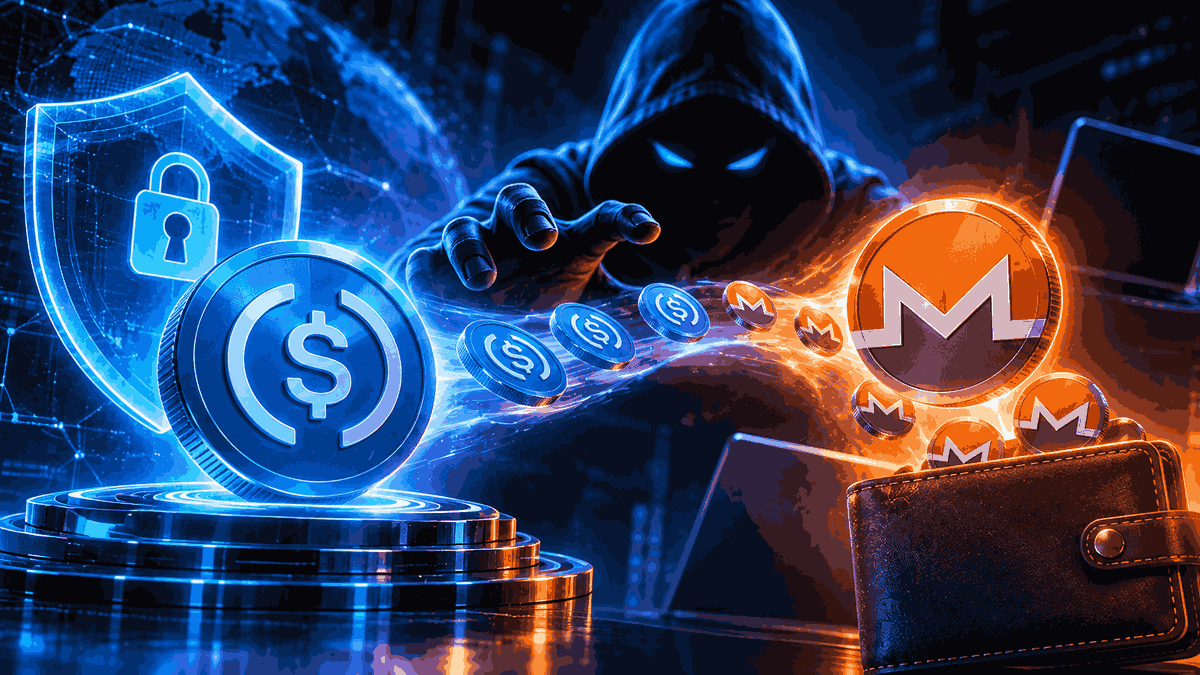
The $6.45 million crypto theft slipped beyond Circle’s control because the attacker rapidly converted the stolen USDC into assets that Circle has no power to freeze—specifically Ethereum (ETH) and the privacy coin Monero (XMR). Circle, as the issuer of USDC, can only blacklist and freeze USDC tokens on flagged addresses; it has no authority over ETH or Monero on their respective blockchains.
The Exploit: A Permissioned Key Compromise
The theft did not stem from a flaw in the Safe wallet’s core contracts. Instead, it involved a compromised key and an overly permissive permission policy set through the Zodiac Roles module. This module allows specific keys to move funds within preset limits without requiring multiple signatures for every transaction. The attacker exploited these existing permissions to drain ~$4.3 million in USDC and ~$1.7 million in syrupUSDC (a yield-bearing token from Maple Finance) from the wallet.
The Laundering: Swapping to Unfreezable Assets
Once the funds were out, the attacker quickly moved them through services designed for privacy and speed:
ETH Conversion: Within less than an hour, the receiving wallet swapped the USDC into Ethereum (ETH), an asset Circle cannot freeze.
Monero Swap via Wagyu: A significant portion—around $1.2 million—was routed through Wagyu, a non-custodial swap service that explicitly requires no identity verification (KYC) and allows users to exchange crypto for native Monero without creating an account.
Monero Purchase on Hyperliquid: Additionally, ~$813,000 was used to buy Monero on the trading platform Hyperliquid, which Wagyu uses to route orders.
Why Monero is Key
Monero is a privacy-focused cryptocurrency built to conceal the sender, receiver, and amount of each transaction. Once funds enter the Monero network, they become extremely difficult, if not impossible, to trace—unlike transparent assets like USDC. This makes it a preferred tool for attackers seeking to obscure the money trail.
The Remaining USDC: A Limited Window
Only a small fraction—approximately $236,000 in USDC—was still sitting in a flagged address as of Monday afternoon. That slice remains within Circle’s reach and could potentially be frozen if Circle acts. However, the vast majority of the stolen funds had already been converted into assets that are beyond Circle’s technical and legal control.
The Zodiac Roles Exploit: A Failure of Policy, Not Code
Both Safe and Zodiac were quick to confirm that no smart contract vulnerability existed. The failure was architectural, sitting at the intersection of key management and permission design.
We were informed of a potential theft from a Safe using the Zodiac Roles Modifier.
We found no contract vulnerability. A role member key, probably compromised, sent a transaction that a custom policy allowed but likely never intended.
— Zodiac (@zodiaceco) November 16, 2026
The Zodiac Roles Modifier is an add-on that lets Safe wallet owners delegate specific transaction rights to individual addresses. An authorized “role member” can execute certain actions without gathering the full multisignature set for every transaction. Permissions can be scoped by allowed addresses, callable functions, parameter limits, and usage thresholds.
In this case, Zodiac’s co-founder Johannes Moormann stated that the transaction came from the key of a long-standing role member, which was most likely compromised through an undisclosed vector. Critically, the wallet’s custom permission policy authorized the transfer—the module functioned exactly as configured, but the configuration permitted a transfer it was almost certainly never intended to allow.
This is a crucial distinction: the attacker did not bypass security checks. They used an authorized route whose restrictions were too permissive. The exploit was not a break-in; it was a misconfiguration weaponized through a stolen key.
This is also not an isolated incident. The Zodiac ecosystem has now been involved in multiple Safe-related failures:
In May 2026, a module exploit affected 86 Safe wallets on Ethereum and Base.
In June 2026, a Zodiac Delay Module flaw allowed attackers to steal about $1.5 million from Gnosis Pay users.
An earlier Gnosis Pay incident was traced to a software flaw dating back to October 2023.
The pattern is clear: third-party permission modules layered on top of multisig wallets are becoming the weakest link, even when the underlying Safe contracts and the Zodiac module code itself are technically sound.
The Laundering Pipeline: Speed, No-KYC, and Privacy
The attacker’s laundering strategy was designed for one purpose: move the funds beyond the reach of Circle’s blacklist before any freeze could be enacted.
Step 1: USDC → ETH (Under One Hour)
Etherscan records show the receiving wallet began swapping USDC into ETH in under an hour after the drain. This is the critical first move. Circle can blacklist USDC addresses, but it has no authority over ETH. Once the USDC was converted, the largest portion of the haul was already outside Circle’s control.
Step 2: Routing Through Wagyu (No-KYC Swap Service)
Approximately $1.2 million was routed through Wagyu, a non-custodial swap service that explicitly does not request identity documents. Wagyu positions itself as a no-KYC route between Monero, other cryptocurrencies, and cross-chain infrastructure.
Wagyu’s design makes it a natural laundering conduit: no account creation, no identity verification, and direct swaps into Monero. The service has also been linked to other major thefts—a $106 million EU crypto theft in early November 2026 also used Wagyu to convert funds into Monero.
Step 3: Monero Purchases on Hyperliquid
Separately, PeckShield reported that approximately $813,000 was used to buy Monero (XMR) on Hyperliquid, the trading platform that Wagyu routes orders through. Bitquery’s independent investigation traced funds through five additional wallets to Hyperliquid, where associated accounts purchased approximately 1,947.58 XMR1 tokens for a combined $1.01 million.
#PeckShieldAlert Specter has reported that a Gnosis Safe may have been compromised, resulting in $6.45M being drained, including $4.3M in $USDC and $1.7M in $syrupUSDC. The hacker has spent ~$813K to buy $XMR on Hyperliquid. pic.twitter.com/BLqlcswoO8
— PeckShieldAlert (@PeckShieldAlert) November 16, 2026
The slight discrepancies between PeckShield’s $813,000 figure and Specter’s $1.2 million figure likely represent separate conversion batches rather than a single total, and neither source provides a complete accounting of every asset.
The key takeaway: more than $1 million of the haul entered Monero, and the on-chain trail effectively goes dark at that point.
Why Monero Is the End of the Line
Monero is not merely “private” in the way Bitcoin is pseudonymous. It is private by default and by design, using three interlocking cryptographic protocols:
Ring Signatures: The sender’s real input is mixed with 15 decoy inputs (a minimum ring size of 16), making it statistically impossible to determine which input is the real spend.
Stealth Addresses: Each payment generates a one-time address, so the recipient’s public address never appears on the chain.
RingCT (Ring Confidential Transactions): The transaction amount is cryptographically concealed while the network can still verify that no coins were created from nothing.
Because these privacy features are mandatory, there is no way to accidentally send a transparent Monero transaction. On-chain, an analyst has almost nothing to follow: the ring hides which input is real, the stealth address breaks the link to the recipient, and the concealed amount cannot be used to match outputs to inputs.
The Limits of Monero Tracing
Monero is not absolutely untraceable. Commercial analytics firms like Chainalysis, Elliptic, and TRM Labs provide limited Monero heuristics but cannot produce deterministic Monero attribution. Investigators have made partial progress through off-chain evidence: exchange records, IP address correlation, timing analysis, device seizures, and operational errors.
However, as of late 2026, confirmed on-chain cryptographic tracing of Monero has not been publicly demonstrated. A proposed upgrade called FCMP++ (Full-Chain Membership Proofs) would replace 16-member rings with proofs over the entire output set, further strengthening privacy—but it has not yet been deployed on mainnet as of November 2026.
For the stolen funds that entered Monero, the practical reality is that the on-chain trail is effectively dead. Any recovery would depend on the attacker making a mistake off-chain—such as eventually converting Monero back to a transparent asset through a KYC-regulated platform.
Circle’s Freeze Power: Real but Narrow
Circle’s ability to freeze USDC is a smart contract function. The USDC token contract maintains a blocklist (blacklist) controlled by Circle. Once an address is added, it can no longer send or receive USDC. The balance remains on-chain but becomes permanently inaccessible until Circle removes the restriction.
This power is significant: Circle froze more than $1.1 billion in USDC after the October 29 Binance hack. However, Circle CEO Jeremy Allaire has stated that Circle freezes USDC wallets only when directed by law enforcement or courts, not unilaterally in real time during an exploit.
Crucially, Circle’s authority is limited to USDC (and EURC). It cannot freeze ETH, Monero, or any other asset. As long as the stolen USDC remained USDC, Circle could act. The moment it was swapped into ETH, Circle’s leverage evaporated.
As of Monday afternoon UTC, one flagged address still held approximately $236,000 in USDC—a small slice that remained within Circle’s reach. The vast majority had already been converted beyond recovery.
Broader Implications: What This Attack Reveals
1. Multisig Is Not a Panacea
Multisig wallets are marketed to treasuries and DAOs precisely because no single signer can move funds. But delegated role keys weaken that assumption. Organizations using permission modules must audit which addresses hold roles and what parameters those roles permit. A compromised role key, paired with an overly permissive policy, can achieve what a single signer never could.
2. The “Freeze Power” Arms Race Is Asymmetric
Stablecoin issuers tout freeze-and-seize tools as a competitive advantage over banks. But that advantage only exists while the funds remain in the stablecoin. Attackers have adapted: the standard playbook now involves converting to ETH and Monero within minutes, rendering the freeze power irrelevant. Regulators, particularly in the EU, are moving toward mandatory built-in stablecoin freeze rules, but these rules address the stablecoin layer, not the cross-asset laundering layer.
3. Privacy Coins Face Growing Regulatory Pressure—but Remain Accessible
Monero has faced 73 exchange delistings in 2025 alone, and major platforms like Binance and Kraken have either delisted XMR or imposed strict KYC and withdrawal limits. The EU’s MiCA framework is set to ban custody of anonymity-enhancing coins for licensed firms, with full custodial bans by 2027.
Yet the existence of no-KYC swap services like Wagyu and Hyperliquid’s permissionless XMR markets means that determined actors can still access Monero without passing through regulated intermediaries. The regulatory squeeze is fragmenting liquidity, but it has not closed the door.
4. Hyperliquid Is Becoming a Laundering Hub
Hyperliquid’s permissionless design enables XMR swaps and fund parking. On-chain researcher ZachXBT has warned that FreedomXMR, a service based on Hyperliquid Core, is now being used to launder funds from notable exploits, offering direct swaps for Monero. The BlueMove hacker also laundered funds through Hyperliquid and Monero, and Chainalysis has identified the Hyperliquid-to-Monero route as an advanced cross-chain laundering pattern.
What Happens Next
The immediate open questions are narrow:
Will Circle freeze the remaining ~$236,000 in USDC? That is the only slice still within reach, but it represents less than 4% of the total loss.
Will the wallet owner come forward? The affected entity has not been publicly identified, which limits both recovery efforts and accountability.
The broader lesson is more uncomfortable. This attack did not require a zero-day vulnerability, a protocol exploit, or a cryptographic break. It required a stolen key and a permission policy that was too generous—and then a 60-minute window to convert into assets that the issuer cannot touch. As long as that window exists, and as long as no-KYC swap services and privacy coins remain accessible, the freeze power that stablecoin issuers advertise will remain a conditional tool, not a guarantee.

Liam Foster follows crypto markets from France, with a close eye on Bitcoin, Ethereum, Layer 1 assets, derivatives, sentiment and smart money flows. His coverage looks past the daily price move to understand what is happening underneath: liquidity, leverage, positioning and the behavior of larger players.
Liam’s style is calm, sharp and deliberately anti-crystal-ball. He does not frame every market move as a breakout or collapse. Instead, he focuses on what the data can actually support, where traders may be crowded and when a signal deserves attention without becoming a prediction.