


Bitcoin is not simply “breaking” its seasonal patterns; it is being structurally re-engineered away from them. The two consecutive October declines in 2025 and 2026 do not prove that “Uptober” was a myth, but they do demonstrate that the calendar-based trading heuristic has been overwhelmed by a different set of forces: institutional capital flows, macroeconomic data dependence, compressed volatility, and a security environment so severe that October 2026 earned the grim moniker “Hacktober.”
The seasonal pattern has not vanished from the data—October still holds the strongest historical median return of any month—but the mechanism that once produced that pattern has been displaced by a market in which demand responds to liquidity, interest rates, and operational risk far more than to the page of a calendar.
The much-anticipated Uptober never materialized this year.
Bitcoin fell 7.2%, making October its third negative October since 2016, its second consecutive monthly decline, and its worst October in the past decade. pic.twitter.com/lbbSAQTzSD
— CryptoJack (@cryptojack) November 2, 2026
The Historical Case for “Uptober” Was Real, Not Imaginary
The “Uptober” narrative did not emerge from folklore. According to CoinGlass data cited across multiple analyses, October historically delivered Bitcoin’s highest median monthly return at 15.4%, with gains in 10 of 13 years through 2025 . A separate ten-year series from 2016 to 2025 shows October finishing higher in eight of ten years, with an average gain of 17.8% in the years before 2026 . This was, by any reasonable statistical standard, a genuine seasonal regularity—strong enough that traders began positioning for it in advance.
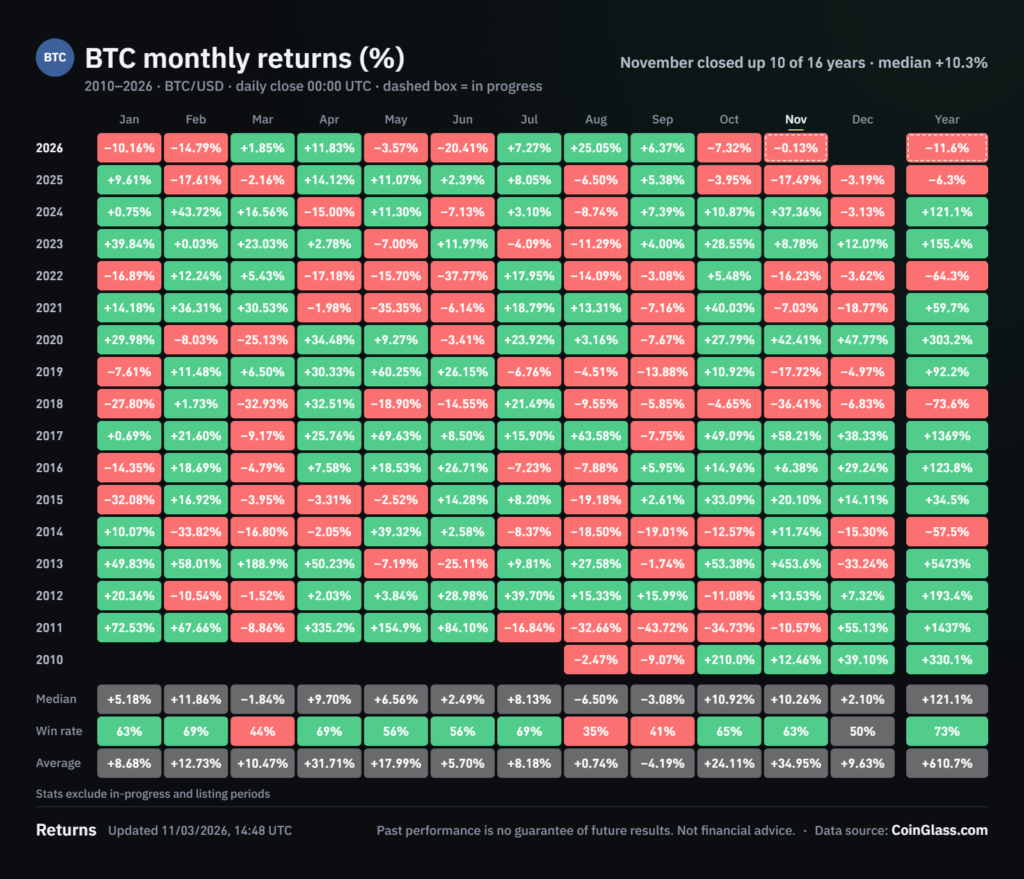
That anticipatory positioning had a second-order effect: it distorted the month immediately preceding October. September, historically regarded as Bitcoin’s weakest month, has posted gains every year since 2023. Kaiko researcher Andrew Yang attributed this to traders buying ahead of an expected October rally, which means the seasonal bid that once arrived in October was being pulled forward into September.
When a seasonal trade becomes widely expected, the returns migrate to the period before the crowd arrives, leaving the named month itself with less upside. This is the first mechanism by which “Uptober” began to erode from within: the pattern was arbitraged by its own popularity.
2026: The Weakest October in the Modern Series
The 2026 October result was not a marginal miss. Bitcoin closed the month at $77,424, down 7.3% from the September close of $83,556, making it the weakest October since at least 2016. The month began at a local high of $87,249 on 2 October and then slid in stages, with the final week delivering the decisive damage.
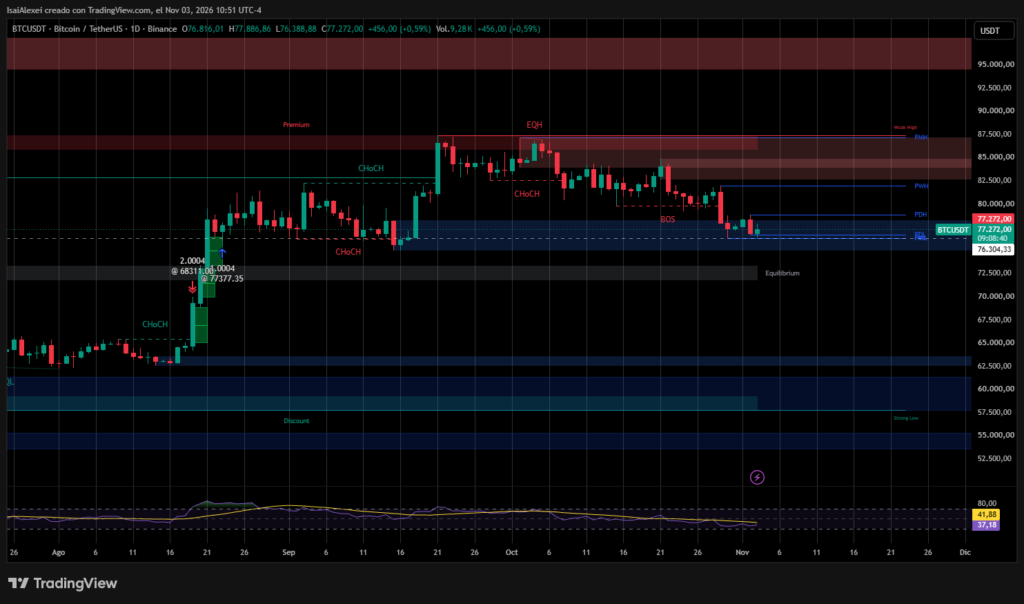
By month-end, Bitcoin was down 11.5% year-to-date and approximately 38% below its all-time high of $126,296, set on 6 October 2025.
Crucially, this was the second consecutive red October. October 2025 had already closed down roughly 4%, which means the 2026 decline cannot be dismissed as a one-off shock . The back-to-back losses are unprecedented in the recent history of the “Uptober” era and are the core empirical basis for the claim that the seasonal pattern is under stress.
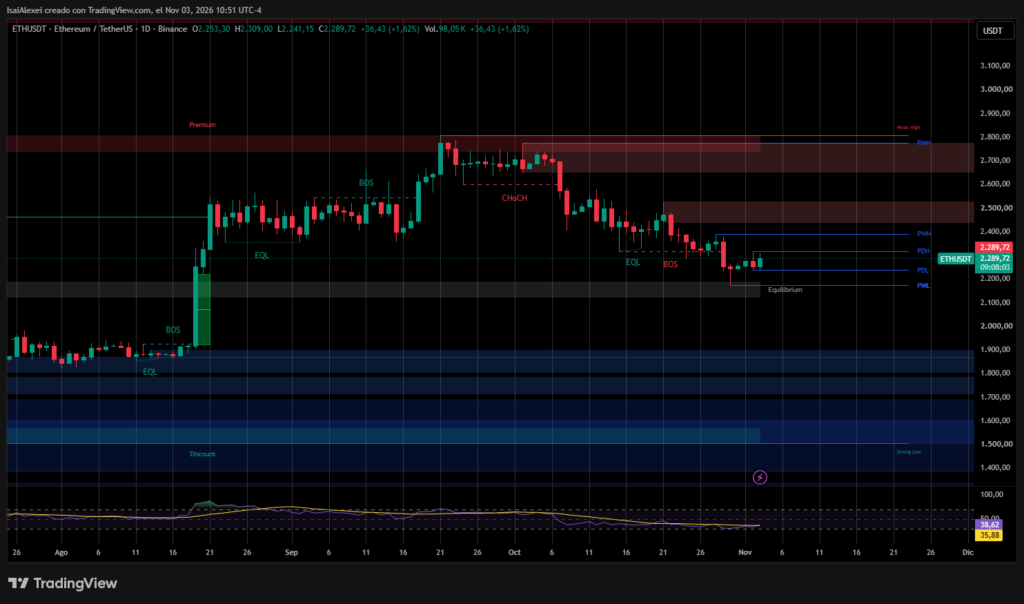
Ethereum fared even worse in October 2026, falling 16.12%, and Bitcoin liquidations reached $3.06 billion, with long positions accounting for 69% of the total—evidence that traders had indeed positioned for the seasonal rally and were forced out when it failed to materialize .
“Hacktober”: A Security Shock That Overwhelmed the Calendar
The 2026 October decline cannot be understood without the security catastrophe that unfolded in the final days of the month. On 29 October, attackers drained approximately $6.3 billion from Binance’s hot wallets across at least 10 blockchain networks within roughly 20 minutes. Binance subsequently froze approximately $3 billion in stablecoins, but roughly $3.3 billion in Bitcoin, Ethereum, and other assets remained outside immediate recovery because those networks lack a central issuer capable of freezing holdings.
Blockchain intelligence firm TRM Labs attributed the attack with high confidence to TraderTraitor, a North Korean-linked group, and identified the use of Ethereum’s EIP-7702 delegation mechanism to convert a compromised hot wallet into a vehicle for asset transfers.
The Binance breach was the largest single crypto theft on record, dwarfing the $1.5 billion Bybit hack of 2025, but it was not an isolated event. PeckShield reported that October 2026 saw 56 major hacking attacks with total losses of $6.48 billion, a 745% increase from September’s $766.49 million . The top ten attacks alone accounted for 92.3% of the year’s total losses, which stood at $8.6 billion before accounting for frozen and returned funds.
The Binance incident ranked first, followed by the Bitget attack at $387 million and the Liquid Network incident at $320 million. The concentration of losses in a single month—and in a single exchange—transformed October from a season of anticipated gains into a month of operational-risk repricing. The label “Hacktober” is not merely rhetorical; it reflects a measurable regime in which security shocks, not seasonal demand, set the marginal price.
On 28 October, the Federal Reserve held rates at 3.75%–4.00%, but two members voted for a hike . On 30 October, the Nasdaq lost 2.86%, $643 million flowed out of US spot Bitcoin ETFs in a single day, and Bitcoin hit its monthly low of $76,141 . The Binance hack therefore did not occur in a vacuum; it landed on a market already vulnerable to hawkish monetary signals and risk-asset deleveraging. The result was a cascade in which a security event amplified a macro-driven selloff, producing a monthly loss that no seasonal model could have absorbed.
Why the Calendar Has Lost Its Pricing Power
The more important question is not whether October 2026 was red, but why the seasonal mechanism failed. Three structural changes explain the displacement of calendar effects.
First, Bitcoin’s volatility has compressed dramatically. Andrew Yang of Kaiko noted that Bitcoin’s typical monthly move has declined from roughly 14% between 2013 and 2016 to 9.6% since 2024. A seasonal rally of the magnitude that once defined October—median 15.4%—is simply less probable in a market whose baseline monthly swing is now in the single digits. The “Uptober” effect was a product of a higher-volatility, retail-dominated market; as volatility falls, the room for outsized calendar-driven spikes shrinks mechanically.
Second, institutional flows have rewritten the demand function. Justin d’Anethan of Arctic Digital argued that ETF flows and corporate Bitcoin buyers are shaped by liquidity, interest rates, and investment mandates, not by seasonal trading narratives . The flow data supports this: US spot Bitcoin ETFs recorded $515 million in net outflows in October 2026, while spot Ether ETFs saw record monthly withdrawals of $1.61 billion.
Third, Bitcoin is increasingly trading as a macro asset. Yang’s conclusion that Bitcoin “increasingly trades like a macro asset, driven more by economic data and institutional flows than by the calendar” captures the regime shift precisely . The October 2026 final week—Fed hold with hawkish dissents, Nasdaq selloff, ETF outflows, and a historic exchange breach—is a macro-and-operational sequence, not a seasonal one. A market priced by these variables will produce monthly returns that reflect the macro state, not the month’s historical average.
What the Seasonal Skeptics Get Right—and What They Overlook
The cautious position among analysts is that two October losses do not kill “Uptober” as a statistical tendency. Julio Moreno of CryptoQuant noted that October has generally performed better during Bitcoin bull markets and worse during bear markets, making the broader cycle the relevant conditioning variable.
Bitcoin Bull Score Index hits 30, the highest since late October.
The index phase switched from "extra bearish" to "bearish".Bull flags that turned on were: exchange flows, stablecoin liquidity growth and price momentum.
We are still in a bear market, but in a relief rally.… pic.twitter.com/wiivPdWbnn
— Julio Moreno (@jjcmoreno) March 11, 2026
On this view, 2025 and 2026 were not refutations of seasonality but observations drawn from a less favorable phase of the cycle. Markus Levin of XYO added a complementary point: when enough traders expect an October rally, the rally gets priced in before the month arrives, which can leave the month itself flat or negative even if the underlying seasonal impulse was real .
These are valid qualifications, but they do not restore the calendar to its former predictive role. If October’s return depends on the bull/bear cycle, on pre-positioning behavior, on ETF flows, on Fed policy, and on whether a major exchange is hacked in the final week, then “Uptober” is no longer an independent signal—it is a conditional outcome that can be overwhelmed by any of several more powerful variables.
The historical median of 15.4% remains a fact about the past, but it is a fact generated by a market structure that no longer exists. The relevant question for a trader in 2026 is not “what does October usually do?” but “what are the macro and flow conditions, and what operational risks are live?” The calendar has become a weak prior, not a tradeable edge.

Liam Foster follows crypto markets from France, with a close eye on Bitcoin, Ethereum, Layer 1 assets, derivatives, sentiment and smart money flows. His coverage looks past the daily price move to understand what is happening underneath: liquidity, leverage, positioning and the behavior of larger players.
Liam’s style is calm, sharp and deliberately anti-crystal-ball. He does not frame every market move as a breakout or collapse. Instead, he focuses on what the data can actually support, where traders may be crowded and when a signal deserves attention without becoming a prediction.