

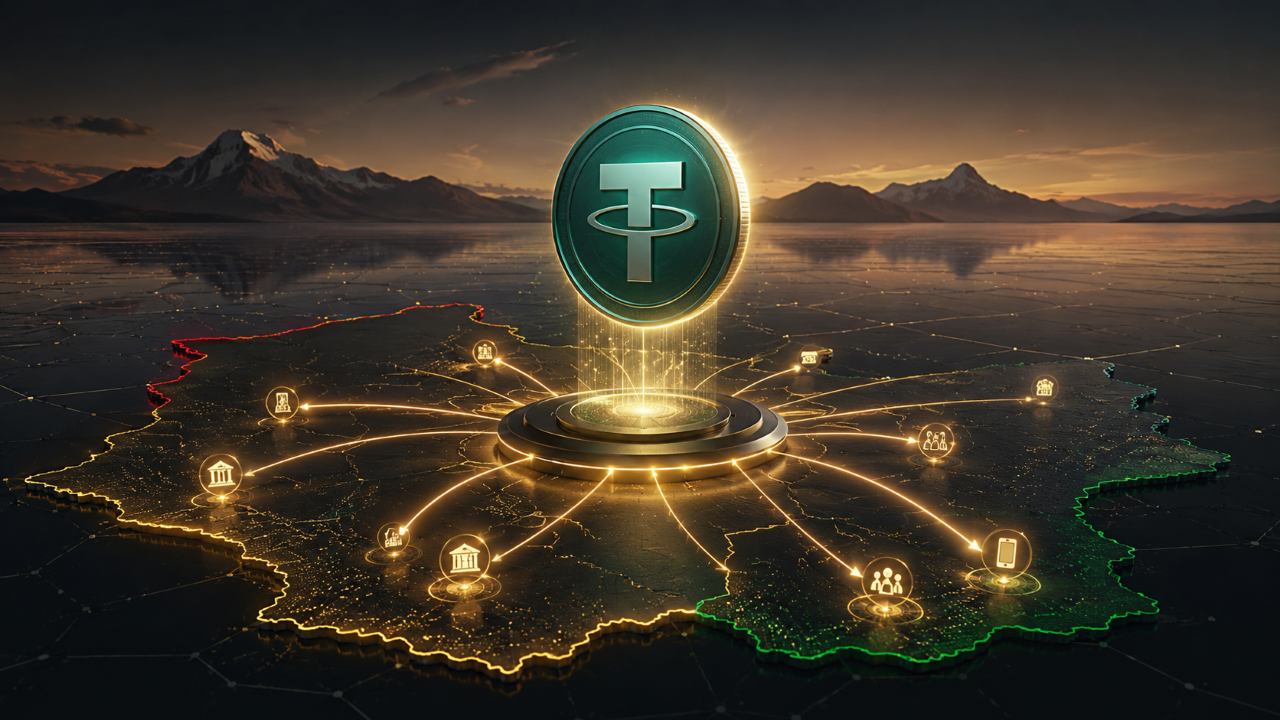
Bolivia is examining whether Tether’s USDT could operate within its national payments system, potentially giving households and businesses a regulated dollar-linked option beside the boliviano and conventional dollar channels. Economy Minister José Gabriel Espinoza said the government is evaluating the framework, but no decision has granted USDT legal-tender status. The proposal signals institutional recognition of a payment behavior already developing outside traditional currency channels. That distinction is crucial. Integrating a private stablecoin could reduce settlement friction during foreign-exchange scarcity, yet it would also place part of domestic payments infrastructure around an asset issued abroad and governed by corporate redemption arrangements.
USDT moves from workaround toward formal infrastructure
Bolivia’s policy reversal began in June 2024, when the central bank removed restrictions that had prevented electronic payment instruments from supporting purchases and sales of virtual assets. Activity accelerated afterward. Transaction volume rose from $46.5 million during the first half of 2024 to $294 million in the corresponding 2025 period, an increase exceeding 630%, while cumulative activity reached $430 million. USDT adoption is therefore being considered after demand became measurable, not before it existed. The government now faces the complicated task of converting informal utility into supervised infrastructure without disrupting users who adopted stablecoins precisely because conventional access proved constrained.
The timing reflects monetary pressure. Bolivia ended its dollar peg in June and moved toward a flexible exchange-rate system as scarce reserves, currency shortages and a widening parallel market strained the previous framework. The central bank displayed an official rate of 10.40 bolivianos per $1 on July 13. A regulated USDT channel could provide transactional dollar exposure without supplying banknotes, potentially helping importers, remittance recipients and merchants settle obligations digitally. Yet easier access to a dollar-linked token could also deepen substitution away from the national currency, especially when inflation and exchange-rate uncertainty already influence household preferences and corporate treasury decisions.
Integration could ease scarcity while raising oversight risks
Implementation would require allowing wallets to connect with banks or payment applications. Authorities would need standards for custody, conversion, liquidity, consumer disclosures, cybersecurity, dispute resolution and the treatment of failed redemptions. USDT can resemble digital dollars in everyday use without carrying the same legal protections as central-bank money or insured deposits. Its value depends on Tether maintaining reserves and honoring redemption mechanisms, while retail users often access it through intermediaries rather than directly. Bolivia must therefore determine who absorbs losses if an exchange, wallet provider, bank integration or blockchain route fails while a payment remains economically important to the customer.
Anti-money-laundering controls may become the constraint. Bolivia remains under increased monitoring by the Financial Action Task Force, requiring progress on strategic deficiencies in its framework against illicit finance. Stablecoin integration would consequently need customer identification, transaction monitoring, sanctions screening, suspicious-activity reporting and coordination among the central bank, financial supervisor and intelligence unit. Bolivia’s experiment will test whether stablecoins can strengthen payment access without weakening monetary oversight. The proposal remains exploratory, but its direction is unmistakable: policymakers are considering bringing a privately issued digital dollar into national infrastructure after years of resistance, because demand has moved faster than the existing system.

Natalie Pierce tracks the parts of crypto that move fast and rarely wait for everyone to catch up. From South Africa, she covers DeFi, AI crypto, hacks, airdrops, sentiment and emerging narratives, especially when user behavior and protocol risk start to overlap.
Her reporting is built for messy sectors. Natalie looks at incentives, reactions, security concerns, social momentum and early signs of traction without pretending every new trend is already proven. Her voice is clear and accessible, but careful enough for areas where excitement can outrun the facts very quickly.