


Crypto markets have always traded on stories, but those stories now expire faster than many teams can build. Themes such as artificial intelligence, DePIN, real-world assets, and gaming can attract capital before products gain regular users. That gap creates a market where attention often develops faster than utility.
Tiger Research noted 2025 as a year of rapid narrative rotation. Market attention moved from AI agents in January to memecoins in February and InfoFi in March. RWAs took April, followed by digital asset treasuries, tokenized stocks, stablecoins, launchpads, perpetual exchanges, x402 payments, privacy, and prediction markets.
In many cases, traders moved elsewhere before the original theme received proper market validation.
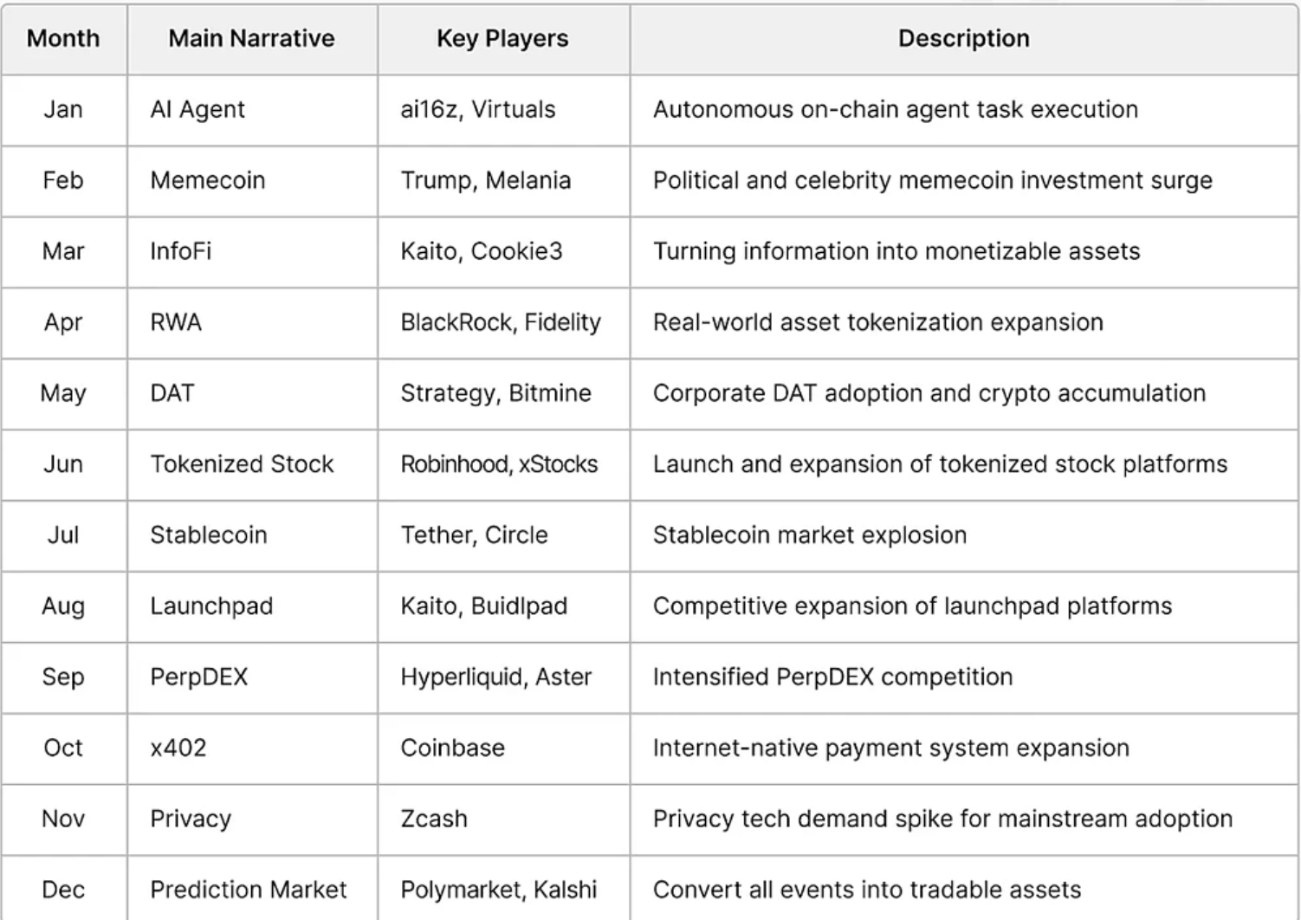
Source: Tiger Research
The pace marks a clear break from earlier crypto cycles. DeFi dominated discussion across much of 2020 and 2021. NFTs took over 2021 while Layer-1 rivalry continued in 2022. Liquid staking and restaking continued to grow in 2023 and 2024. Those themes had enough time to build communities, infrastructure, and recognizable market leaders.
Why Crypto Narratives Now Fade Faster
The current market offers far more tokens, platforms, and trading venues than previous cycles. Social media also compresses discovery, speculation, and disappointment into shorter periods. A new idea can spread globally within hours, attract liquidity, and lose momentum before developers release a usable product.
Competition for attention is also highlighted in CoinGecko’s 2025 investor interest review. Memecoins comprised 25.02% in related categories. AI themes accounted for 22.39%. The top 20 narratives accounted for 70.11% of the tracked interest, down from 78.7% through 2024.
That decline suggests investor attention became more fragmented across a growing number of themes. Stablecoins, prediction markets, and some RWA products have developed measurable demand.
However, token prices can still move before adoption, revenue, or sustainable activity becomes visible. This creates a difficult test for investors separating early product development from short-lived speculation.
A Line Between Hype and Conviction
Pudgy Penguins CEO Luca Netz argues that investors must first decide if a narrative has “meat on the bone.” In his view, some themes begin with ambitious claims but little supporting activity. He described early RWA enthusiasm as an example where large token valuations sometimes appeared before meaningful products.
Luca Netz reveals how to spot when a narrative has run its course.
Jason: "How do you identify that a narrative has run its course?"
Luca: "You first have to define if a narrative is more than a narrative because there are narratives in crypto that are just pie in the sky…… pic.twitter.com/NIIrHdwRxc
— Fibonacci 🥷 (@Fibonacci69) August 2, 2026
Netz also separates market conviction from price performance. Crypto functions partly as an attention market, so falling prices can weaken confidence quickly. Yet a lower price does not automatically invalidate the underlying idea. Narratives can return when products improve, users arrive, or market attention circles back.
His test focuses on conviction after speculation fades. If investors abandon the thesis only after prices fall, the original belief may have depended mainly on momentum. Stronger narratives retain supporters who can identify users, revenue, infrastructure, or another source of lasting demand.
Product-Market Fit Becomes the Harder Standard
Tiger Research’s analysis argues that crypto is moving from broad narrative trading toward a search for product-market fit. Stablecoins, DeFi, RWAs, memecoins, and prediction markets have survived without one theme controlling the entire market.
Their staying power is now dependent on real demand rather than collective enthusiasm. A great narrative can still help raise early capital, but attention can’t sustain an industry forever. Teams need to turn interest into active users, repeat transactions, reliable revenue or useful infrastructure.
Crypto narratives will keep rotating with traders searching for newer opportunities. The stronger themes will not avoid volatility or temporary neglect. They will outlast those periods by offering something users still need after the market finds another story.

I’m a markets journalist with a background in journalism and experience covering both traditional finance and the crypto industry. My work has taken me across stocks, commodities, macroeconomic developments, and digital assets, and I’m particularly interested in understanding how events in one market can influence another. I enjoy looking beyond the headline and finding the context that helps make a story meaningful.
My main areas of expertise include cryptocurrency and blockchain markets, price analysis and predictions, breaking news, Web3 research, and PR writing. I also have a strong focus on editing and refining content, making sure each story is well researched, accurate, and easy to follow. For me, good financial writing is not just about reporting what happened, but helping readers understand why it matters.