


Glamsterdam is one of the most ambitious technical changes that Ethereum has prepared for its main layer. The goal is not simply to process more transactions: the upgrade seeks to reorganize the way the network builds and verifies blocks, while laying the foundations for a more parallel execution and greater use of available resources.
The problem is that scaling a mature blockchain isn’t just about increasing its capacity. Every protocol modification. It adds new conditions that customers, validators, developers, and tools must understand and handle correctly.. That is precisely what Glamsterdam is beginning to show.
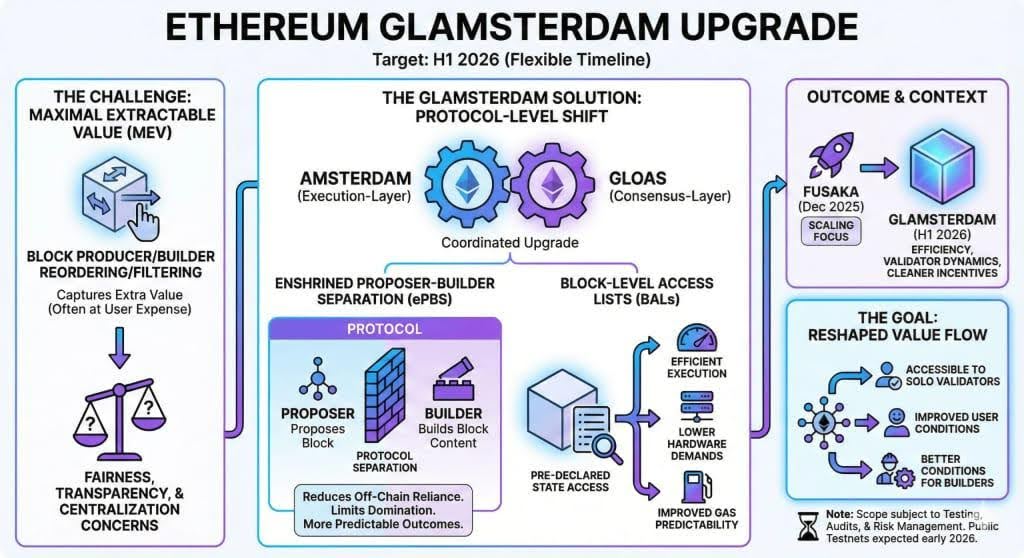
The implementation of the separation between block proponents and builders enshrined in the protocol, known as ePBSIt, is more difficult than expected. The Ethereum Foundation explained that this change forces the protocol to manage the coordination between two participants acting sequentially during the consensus process, including scenarios of disagreement or failure. The concept of partial blocks also becomes part of the considerations of virtually the entire stack.
This is not a minor detail. The more responsibilities that become part of the protocol itself, the greater the number of states, interactions, and exceptional situations that customers must consider.
Ethereum’s Problem Doesn’t End with the Clients
The Block-Level Access Lists take this discussion even further. BAL modify the way Ethereum registers and manages access to the state with the aim of facilitating more parallel execution. At the same time, the changes in gas prices seek to reflect more accurately the work that each operation actually requires.
In theory, these are necessary modifications for the network can continue to grow without its current architecture becoming a bottleneckIn practice, they introduce new rules that can invalidate assumptions that were considered normal for years.
The Ethereum Foundation itself warned that tools that rely on a fixed maximum gas limit, such as wallets, indexers, and estimators, will need to be updated. Even a simple ETH transfer no longer has a uniform structure of 21,000 gas units when the recipient does not yet exist.
Smart contracts are not entirely exempt either. Tests conducted with historical transactions showed that a small group of contracts depends on assumptions about gas consumption that Glamsterdam modifies. Most don’t present problems, but some. They could degrade or stop working without preventative changes.
How Much Complexity Is Too Much?
Here, one of the most important issues appears. Ethereum needs to evolve. A blockchain that aims to function as global financial infrastructure It cannot remain frozen in time to preserve a simple architecture. But neither can it assume that all additional complexity is free.
Each new layer of coordination requires more development work. More tests and more scenarios that need to be verified before touching the main network. It also increases the amount of external software which must remain compatible with the new rules.
Glamsterdam is still in the testing phase, and there is no evidence to suggest that these challenges will compromise the security or stability of Ethereum. In fact, that’s precisely why networks like Glamsterdam exist. Plateau Mountain: to allow developers and operators to encounter problems before the update reaches the long-term test networks and, subsequently, the mainnet.
Therefore, the true test of Glamsterdam will not only be how many additional transactions can process Ethereum.
It will also be necessary to check if the network can absorb all this complexity without turning its maintenance, verification, and development into a bigger problem that the update is trying to fix.
Ethereum is trying to do more. The question is whether it can. Without each new capability making the network proportionally more difficult to understand and maintain.

Emma Lawson writes about the pressure points where crypto meets the outside world: regulation, exchanges, macro policy, tokenized assets and geopolitical risk. From the US, she follows the decisions and events that can change how capital moves, how platforms operate and how digital assets are treated by institutions.
Her work is direct and evidence-led. Emma is less interested in legal theatre than in practical consequences: what changed, who is affected, which risks are real and where the market may be overreacting. She brings a steady voice to complex stories, especially when regulation, infrastructure and global markets start pulling in the same direction.