

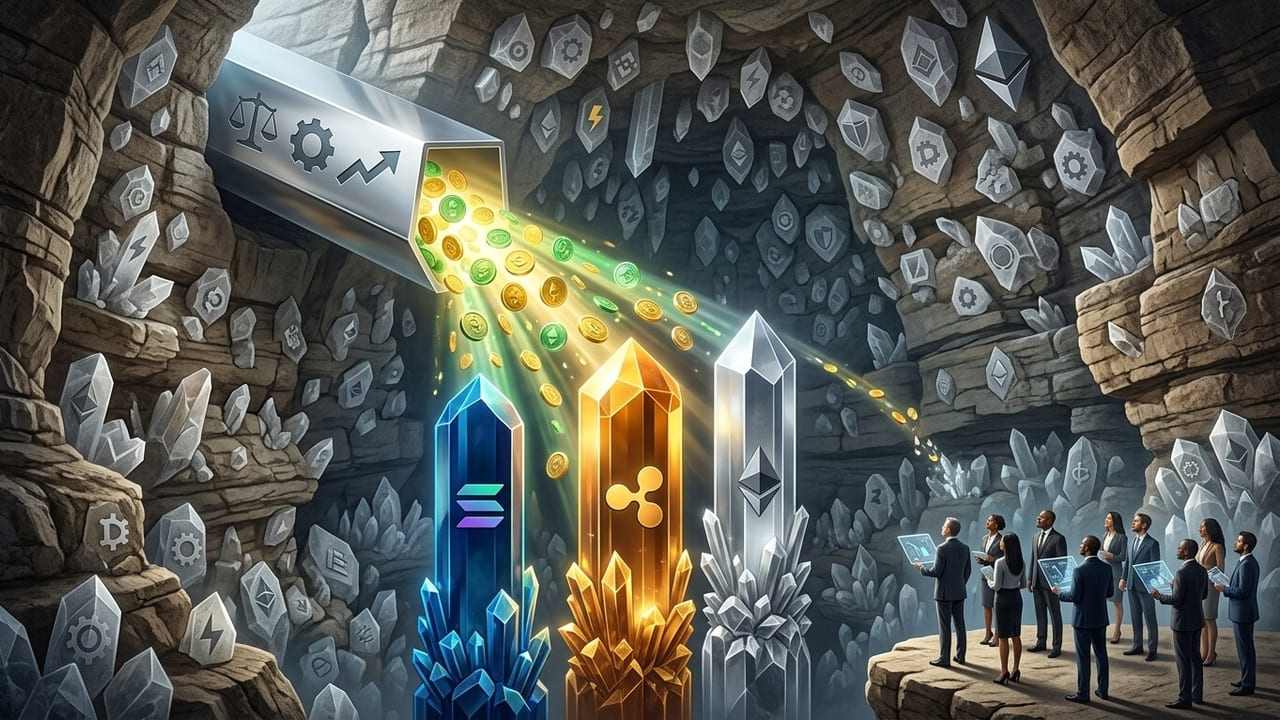
The growth of spot ETFs for Solana, XRP, and other large cryptocurrencies is giving institutions an easier way to gain exposure to the altcoin market. But that does not mean the money will spread across the wider altcoin market. In fact, ETFs could make the market more concentrated.
The main reason is simple: most crypto ETFs are built around one asset. When an investor buys a Solana ETF, the money is mainly being used to gain exposure to SOL. It does not automatically flow into smaller Solana-based tokens or other altcoins.
This is already visible in the market. Solana ETFs have attracted strong interest compared with other altcoin products, while recent activity in the wider altcoin ETF market has remained limited. The Block reported in July that Solana and Hyperliquid ETFs accounted for almost 80% of trading volume among altcoin ETFs outside Bitcoin and Ethereum.
That is important because a traditional altseason usually involves more than just a few large coins rising. Smaller tokens also start attracting money as investors become more willing to take risks. ETF growth does not necessarily create that type of environment.
Institutions are likely to stay with the bigger coins
Large investors normally have different requirements from retail traders. They need assets with enough liquidity to handle large trades, established custody services and a market that can support bigger investments.
That makes assets such as Bitcoin, Ethereum, Solana and XRP easier choices than small-cap tokens.
The difference can already be seen between Solana and XRP ETFs. Bloomberg Intelligence data reported by CoinDesk showed that around half of Solana ETF assets were linked to institutional investors that disclose holdings through 13F filings. XRP ETFs had a much smaller share, at around 16%, suggesting that retail investors play a bigger role in those products.
Even so, both examples point to the same broader issue: investors are choosing individual large-cap assets rather than buying the altcoin market as a whole.
ETF access does not mean every altcoin gets the benefit
There is also a practical limit to how many tokens institutions can access through ETFs.
An ETF needs a suitable market, reliable custody, and enough liquidity. Smaller cryptocurrencies often do not have the same infrastructure as SOL or XRP. As a result, even if institutional demand for crypto increases, the first beneficiaries are likely to be the assets that already have the strongest markets.
This creates a kind of funnel. New institutional money enters crypto through regulated products, but much of it is directed toward a small number of established coins.
That does not mean smaller altcoins cannot rise. A strong move in SOL, for example, could improve sentiment around projects built on Solana. But that is different from a market-wide altseason where hundreds of smaller tokens rally together.
A real altseason would need more than ETFs
For a traditional altseason to develop, investors would probably need to become more comfortable taking risks across the wider crypto market. That could happen if Bitcoin’s dominance falls, Ethereum begins outperforming Bitcoin, or activity across DeFi and other crypto sectors accelerates.
Recent fund-flow data suggests that institutional demand remains selective. CoinShares reported $1.67 billion in weekly outflows from digital-asset investment products on June 1, while only five assets recorded meaningful inflows above $1 million. XRP was among them, attracting $20.3 million, even as Bitcoin and Ethereum recorded outflows of $1.44 billion and $257 million, respectively.
The pattern was even clearer in the ETF market by July. According to The Block, Solana ETFs held about $904 million in assets under management, while Hyperliquid products had attracted roughly $350 million in net inflows.
This suggests that ETF growth does not automatically produce a broad-based altseason. Institutional investors can gain easier access to altcoins while still concentrating their exposure in a small number of established tokens. The result could be a market where SOL, XRP, and a few other ETF-supported assets benefit from new capital while smaller tokens receive little or no institutional demand.
That could change the nature of an altseason. Instead of capital moving broadly from Bitcoin and Ethereum into dozens of smaller cryptocurrencies, institutional flows may increasingly move into regulated investment products tied to a limited group of liquid, recognizable assets.
For that reason, the growth of altcoin ETFs should not be treated as proof that a traditional altseason is underway. ETFs can expand the pool of institutional capital available to crypto, but whether that capital spreads across the broader altcoin market will depend on risk appetite, liquidity, and demand beyond the handful of tokens that already have institutional access.

I’m a crypto and Web3 writer with 2 years of experience covering blockchain, digital assets, and fintech. I’ve written more than 100 SEO-focused articles, including crypto news, educational explainers, and market analysis. Much of my work focuses on Bitcoin, Ethereum, Solana, XRP, ADA, and BNB, particularly their price movements and the broader trends influencing the market.
I also cover DeFi, Web3, Layer 2 networks, and regulatory developments affecting the industry, including topics such as the CLARITY Act. Beyond writing, I have experience with WordPress publishing, fact-checking, proofreading, SEO, and content performance analytics. I enjoy taking technical subjects and turning them into clear, useful stories that readers can actually follow.