


DEX market share used to appear relatively simple. The exchange processing the most volume, attracting the deepest liquidity, and serving the most traders could reasonably claim a stronger position.
Aggregators are making that picture more complicated. A trader using an aggregator does not necessarily choose the exchange that ultimately processes the transaction. The trader chooses what to swap, while the aggregator searches several liquidity sources and determines where the order should be executed.
That creates two different questions: where did the trade happen, and who decided where it went? This distinction matters because aggregator activity has grown large enough to influence how DEX market share should be interpreted. Individual exchanges may still record the volume, but they do not always control the user relationship behind that volume.
More Users May Not Mean More Control
DEX dominance traditionally revolves around trading volume, liquidity, and user numbers. An exchange attracting more traders usually generates more activity and strengthens its market position. Aggregators weaken that direct relationship.
A trader entering through an aggregator becomes a user of the routing layer first. The aggregator then evaluates available venues and determines which exchange should receive the order. Research by BlockScholes validates that individual DEXs effectively compete in the background. Consider two exchanges. DEX A has one million direct users but regularly offers slightly weaker execution. DEX B has 300,000 users but provides deeper liquidity and better pricing.
If a major aggregator handles millions of orders, it could consistently route more volume toward DEX B despite DEX A having a much larger direct user base. DEX B could therefore gain significant market activity without winning those traders itself. That suggests user market share and execution market share are no longer the same thing.
Actual Aggregator Volume Shows Why Routing Matters
According to DefiLlama data, the DEX aggregators processed about $76.16 billion in trading volume over 30 days, while 24-hour aggregator volume stood at $2.226 billion. Jupiter alone handled around $16.98 billion over 30 days.
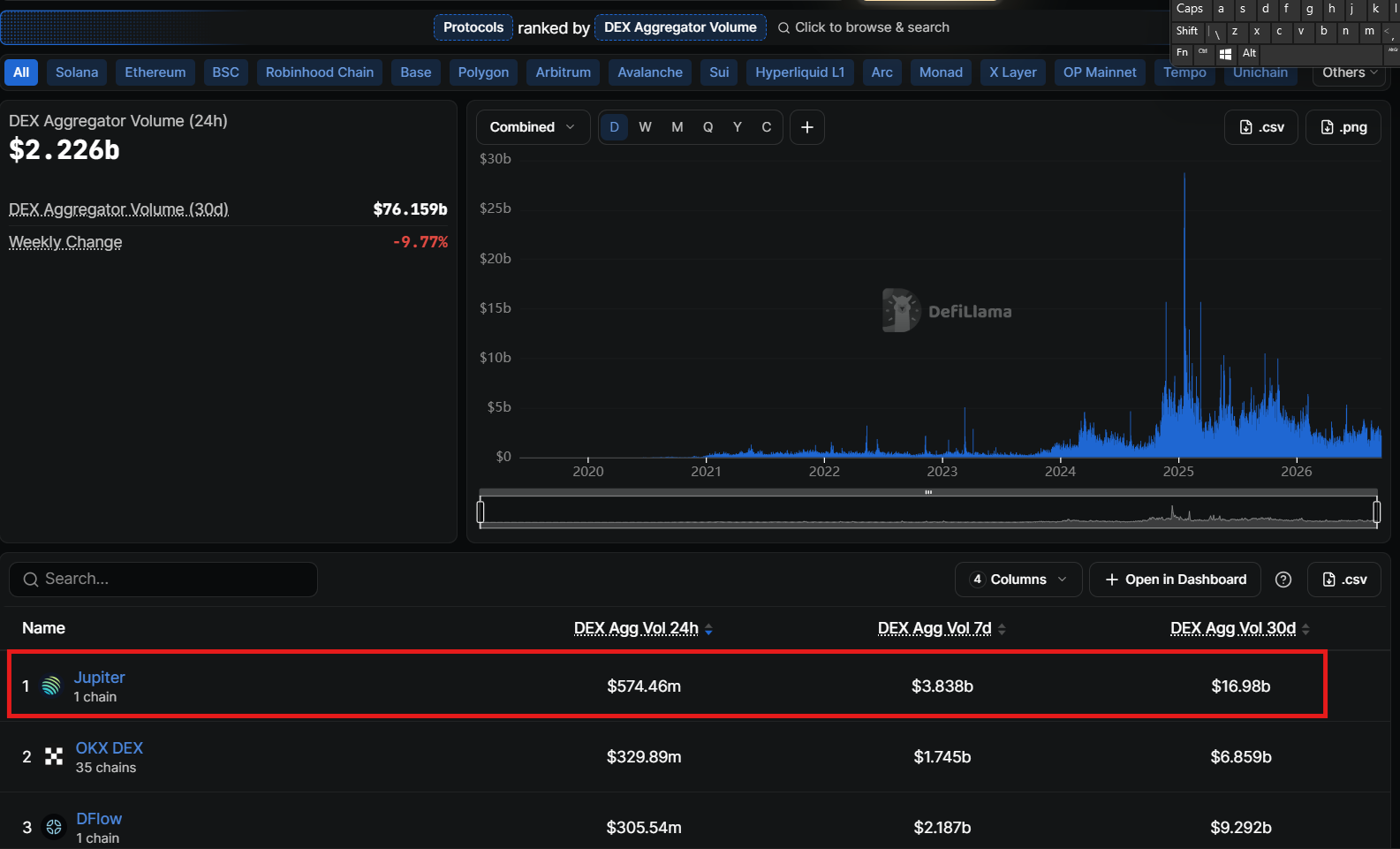
Source: DefiLlama
That means Jupiter accounted for 22.3% of the aggregator volume. The point is not simply that aggregators handle billions of dollars. It is that this volume passes through platforms whose role is to decide where liquidity should be accessed. A DEX may record the transaction, but the aggregator may have controlled the route that delivered it.
Liquidity Still Gives DEXs Their Power
Aggregators cannot operate effectively without strong execution venues. Deep liquidity, low slippage, competitive fees, and efficient smart contracts still give individual DEXs considerable influence.
Market research confirms that if one exchange consistently offers better execution, routing systems have a clear reason to send transactions there. That is why aggregators are not making DEX market share irrelevant. They are making volume alone less complete as a measure of dominance.
The competitive dynamic may also change what exchanges prioritize. DEXs once focused heavily on attracting users directly. Increasingly, they may also need to remain attractive to the algorithms deciding where trades are executed. That means some exchanges may end up competing for routers as much as they compete for traders.
DEX Market Share May Need a New Definition
DEX market share still matters because exchanges provide the liquidity and infrastructure that make decentralized trading possible. But it may no longer tell the full story on its own. A more useful framework could separate the market into two categories.
The first is execution share: which exchanges actually process the trades. The second is order-flow share: which platforms influence where those trades are directed. As aggregators, wallets, and automated routing systems increasingly sit between traders and liquidity pools, this distinction is likely to become more important. To illustrate this, a 2025 Messari report separately shows DEX market share by trading venue and trade source. For example, it reported Raydium with 43% of spot DEX market share, while separately stating that 24% of Q1 spot DEX volume was initiated via Jupiter and 31% via Raydium.
A DEX can win the transaction. An aggregator can influence who gets that transaction. That means having the largest user base or the highest exchange volume may still demonstrate strength, but neither automatically proves control over the trading decision.
DEX aggregators are therefore not making individual exchange market share meaningless. They are making it less meaningful when viewed alone. The next major question in decentralized trading may not simply be which exchange has the most users or volume. It may be who controls where those users’ orders go.

I’m a blockchain, Web3, and market news writer with more than five years of experience covering the cryptocurrency and fintech industries. My work focuses on turning complex market developments, product launches, data, and technical topics into clear and useful content. I regularly write about Bitcoin, Ethereum, DeFi, stablecoins, tokenization, ETFs, Web3 startups, fintech, AI, regulation, on-chain data, and market structure, combining news judgment with research and data-driven analysis.
Alongside daily news and market coverage, I have experience producing SEO articles, X threads, newsletters, research summaries, founder content, and social media posts. I also work on headlines, meta descriptions, and content designed for platforms such as Google Discover.